Designing a context management system for AI Powered Dev Teams
TL;DR
Actual AI is a seed-stage startup building an autonomous agent that reads a team's codebase and manages their architectural decisions, keeping every coding agent aligned. As the founding product designer, I led the 0→1 design of the full product: agent dashboard, onboarding, CLI, GitHub integration, and a Storybook component library. 15 enterprise clients since launch, 1,000 teams on the waitlist. Designed for developers who build with AI, using AI to design and ship it.
Organization
Actual AI
Role
Founding Product Designer
Duration
6 months
Team
Founder, CTO, 5 Developers
Tools Used








// HOW I WORKED
Solo designer on a fast engineering team, shaping what got built and building it with them!
“she created effective user experiences and designs for our product, and led several initiatives to improve the UX with directed feedback from users. She owned our frontend designs and pages in Storybook, led weekly discussions on the user experience and new features, and contributed directly to the source code of our full-stack application...”

Austin Born · Lead AI engineer
"Manya is an exceptional designer who helped us find design consistency in an evolving product at an early stage startup. She balanced forward-looking design direction with providing on-the-fly support to developers during implementation. She also made important contributions in code, creating design system components..."
Brian Perry · Founding engineer

// Background
Designing an Agentic context management system for AI Powered engineering teams.
Every codebase runs on architectural decision records called 'ADRs', like using Tailwind over styled-components. Teams rarely write these down, so coding agents like Cursor and Claude Code each guess, and the codebase drifts.
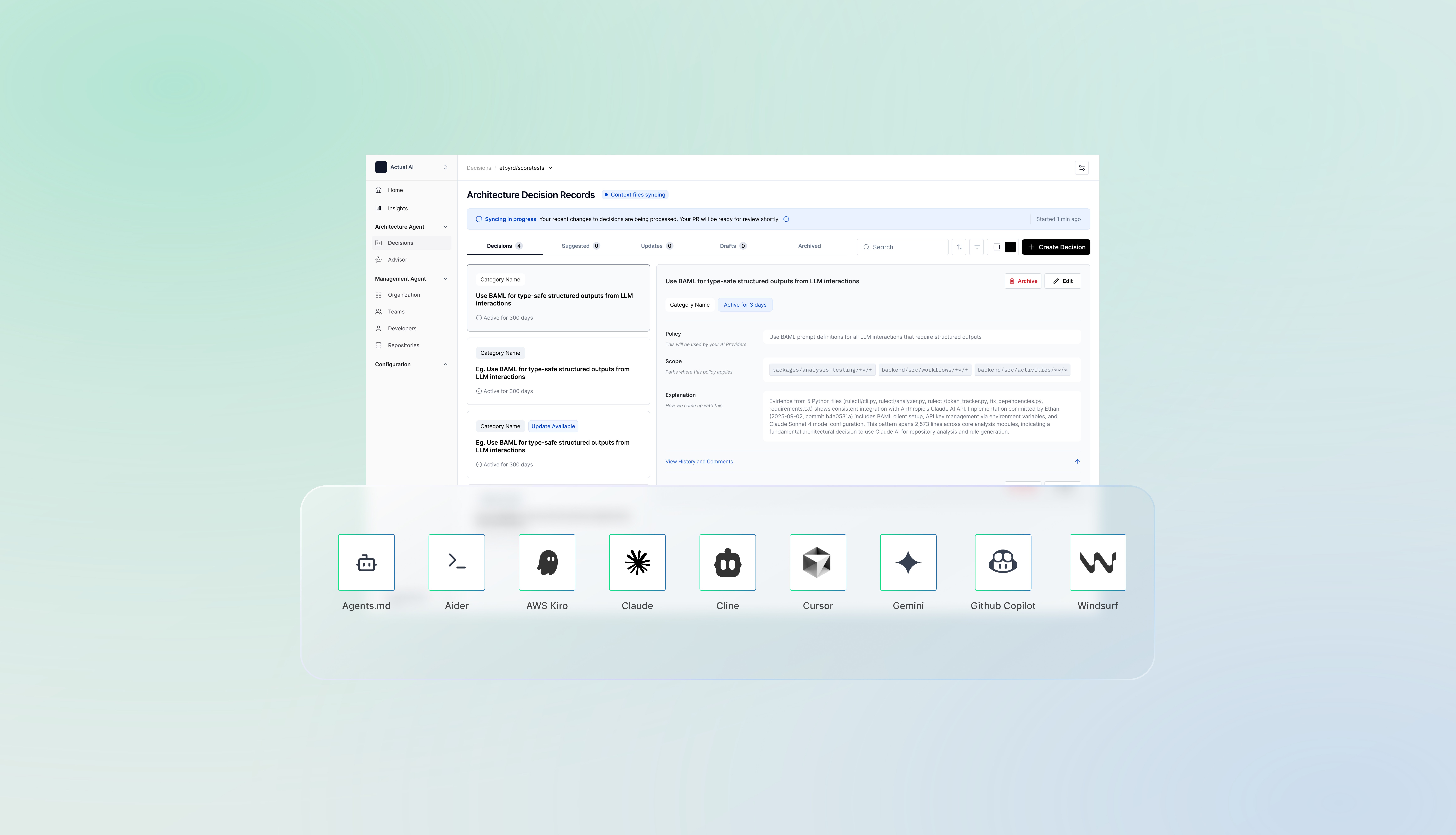
Actual AI reads a codebase, turns the team's existing patterns into structured decisions, and syncs them to every coding agent as shared context, so nothing drifts.

When I joined as the founding product designer, the agent worked but the product didn't. It could read a codebase and surface decisions, but what came back was a wall of raw output. The challenge lived in that gap: turning something technically powerful into something a developer would actually believe in.
// IMPACT
Teams on the waitlist since the product launched in May.
X
Increase in code ship velocity, enabled by the autonomous agent workflows.
%
Reduction in front-end implementation time after I built components in Storybook.
// WHAT I SHIPPED

Architecture Management Agent
Designed the product experience for an autonomous agent that manages architectural decisions across a team's entire codebase.
Shipped · Live

Configurations
Gives users control over rules and agent behavior. Connects to integrations like GitHub and Slack.
Shipped · Live

Onboarding
A smooth end-to-end experience — product tour, setup checklist, and repo analysis — that gets teams to value fast.
Shipped · Live

CLI
The same agent capabilities through a TUI — for developers who live in the terminal.
Shipped · Live

Marketing Website
Designed and shipped actual.ai — the product story, positioning, and site — in Cursor in a week.
Shipped · Live

Design System
Figma and then react components in Storybook so engineering can build without waiting on design.
In progress · Live
// USER PROBLEM
Developers don't trust AI to write their architecture.
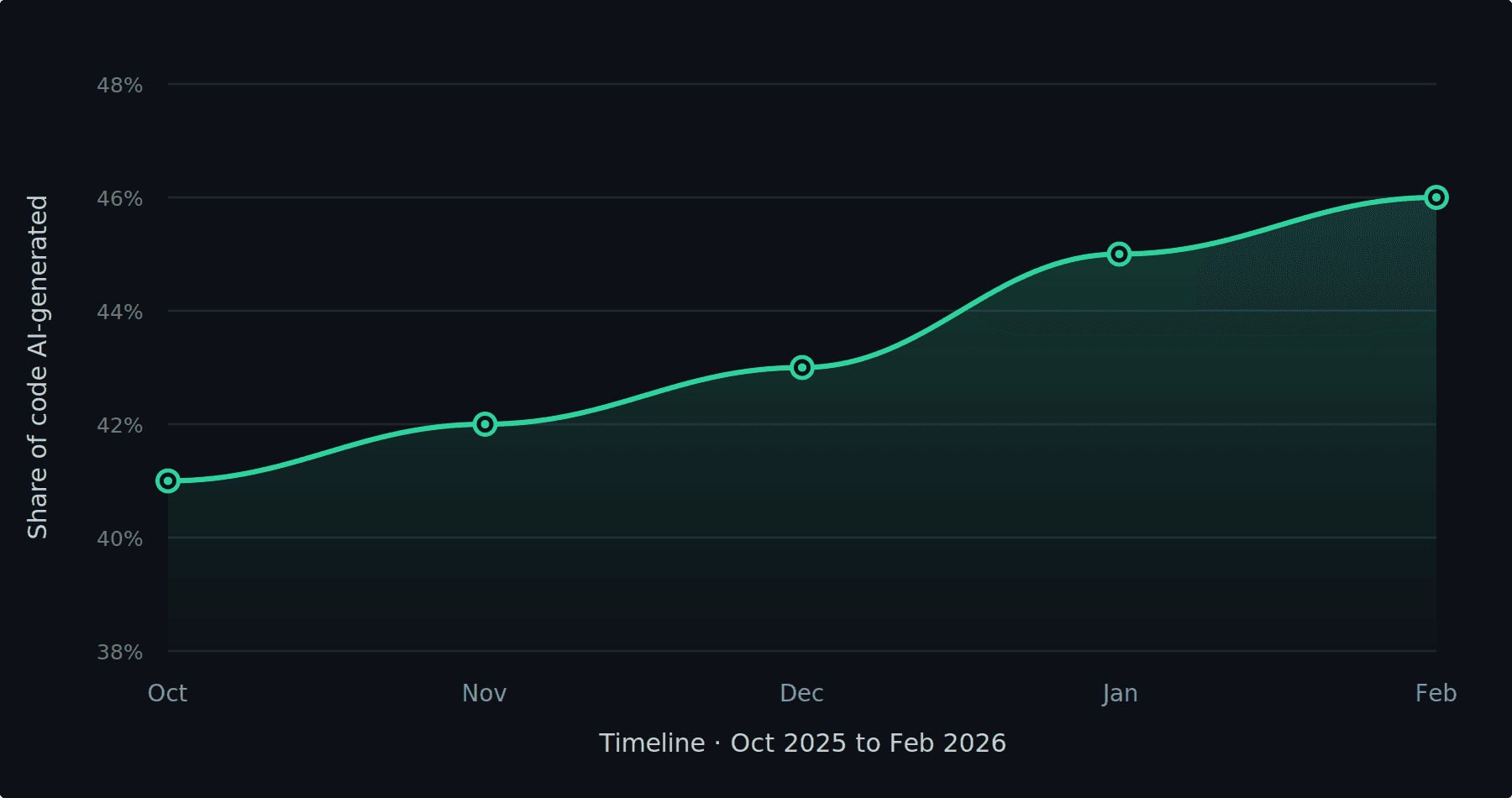
Sources: GitHub Copilot reports an average 46% of code is now AI-generated, up from 27% in 2022. 41% industry average reported in late 2025. Quotes adapted from sessions during user research.
The product launched into a moving target. In a few months, what users said about AI in their codebase changed completely.
" I don't trust it to make architecture decisions. I'll review every line. "
Engineer · Oct 2025
" Honestly? I haven't read most of what shipped this sprint. The agents handle it."
Same engineer · Feb 2026
UX PROBLEM 01
How do you introduce a new way of working?
ADRs traditionally live in Slack threads, Word docs, Confluence pages. The product asks teams to manage them somewhere new, generated by an agent they're still learning to trust.
UX PROBLEM 02
How do you get a developer to trust an agent that writes to their codebase?
Trust in AI code suggestions is one thing. Trust in an agent creating pull requests against production architecture is another.
// PRINCIPLES
Designing through friction and noise.
An early product trying to build trust
An early product asking developers to let an AI write to their codebase has to earn trust before anything else. Every interface choice gets weighed against whether it earns or burns it.
Building for tools that keep changing.
Dev tooling runs on flavor of the month. Components, flows, and integrations are built to absorb new tools without re-architecting each time.
// INITIAL OFFERING
A flow built around human approval
The experience I designed put the user at every checkpoint. The agent surfaces a pattern, the developer reviews and accepts it, then ships the rule to their codebase as a PR.
STEP 00
Suggested
Agent surfaces pattern
STEP 01
Review & accept
User discusses, accepts
STEP 02
Generate PR
User gives permission
STEP 03
Accept PR
User ships to codebase
// ADOPTION CHALLENGE
Giving users too much control?
This was the first time the product had been in front of users. I ran testing in two parallel tracks through Toptal and managed both.
35
Users tested
Two parallel tracks
20
Friends and Family
Moderated usability session
15
2 X UW Research Team
Structured Usability Study with Partner Research Teams
FINDING 01
Every step felt like one too many
Users hit the multi-step flow and bounced. The friction wasn't from the AI being wrong — it was from being asked to weigh in on things they didn't feel they needed to.
FINDING 02
But they wanted more visibility into what the agent was doing
Less control over decisions. More visibility into the work. Show too much and they'd shut down. Show nothing and they wouldn't trust it.
// THE PIVOT
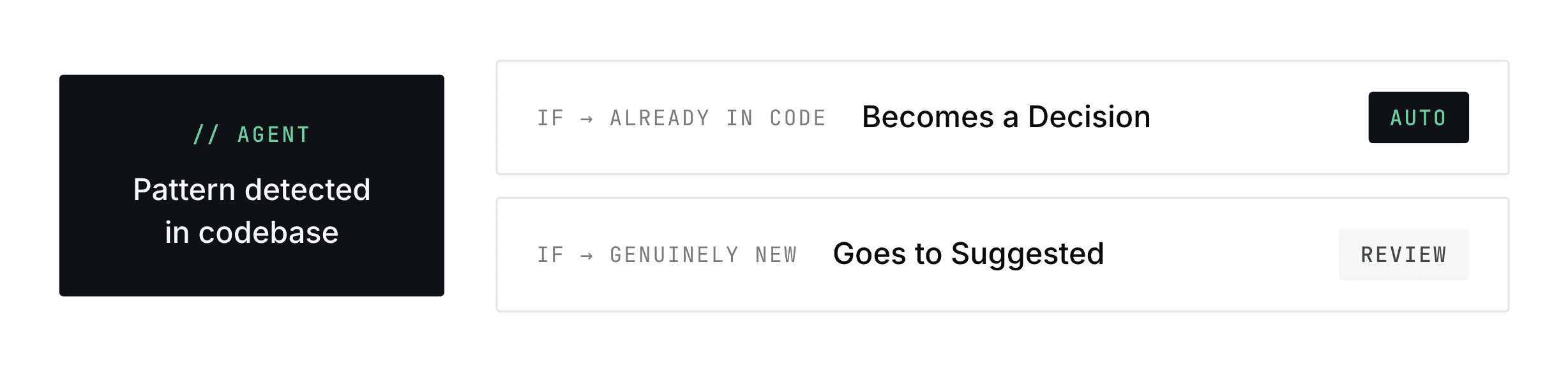
Not every decision needs a decision
The agent wasn't proposing new architecture. It was reflecting back what the team had already written. Asking developers to approve those patterns was asking them to ratify decisions they'd made months ago. I split what the agent surfaced into two states instead of one.
// FINAL SOLUTION
The system that turned an untrusted agent into a tool developers rely on.
I built the first version around control. Every step needed a developer's approval, because that felt like how you earn trust. Testing showed me something else. Developers wanted to know what the agent did and why. Once they had that, the approval steps just slowed them down.
So I designed the pivot around information. Give developers the full picture at the moments that matter, keep everything else quiet, and the hard decisions start to feel easy. That idea runs through everything we shipped. Here are a few of the surfaces where it took shape.
Home dashboard: Cut through the noise of a complex agentic workflow and see exactly what needs your attention right now.
Developers using coding agents are managing decisions, PRs, pattern syncs, and repo analysis all at once. The dashboard surfaces only what is unresolved or urgent. Nothing is buried.
Repository decisions: Every architectural choice your team has made, with the most time-sensitive ones always at the top.
PRs that conflict with active decisions come first because they are already in review. Patterns flagged but not yet synced come second. Decisions currently being generated come last. That order came directly from how developers told me they think about their day.
The architecture agent: Make one change to a decision, and every coding agent your team uses gets updated through a PR.
These are high-stakes, high-trust actions. A developer changing an architectural rule needs to see exactly what will be affected before committing. The interface shows the scope of every change upfront: which agents, which files, what the diff looks like.
// Glimpse into the backend
The engineers handed me a raw JSON payload and I turned it into something a developer could actually read during onboarding.
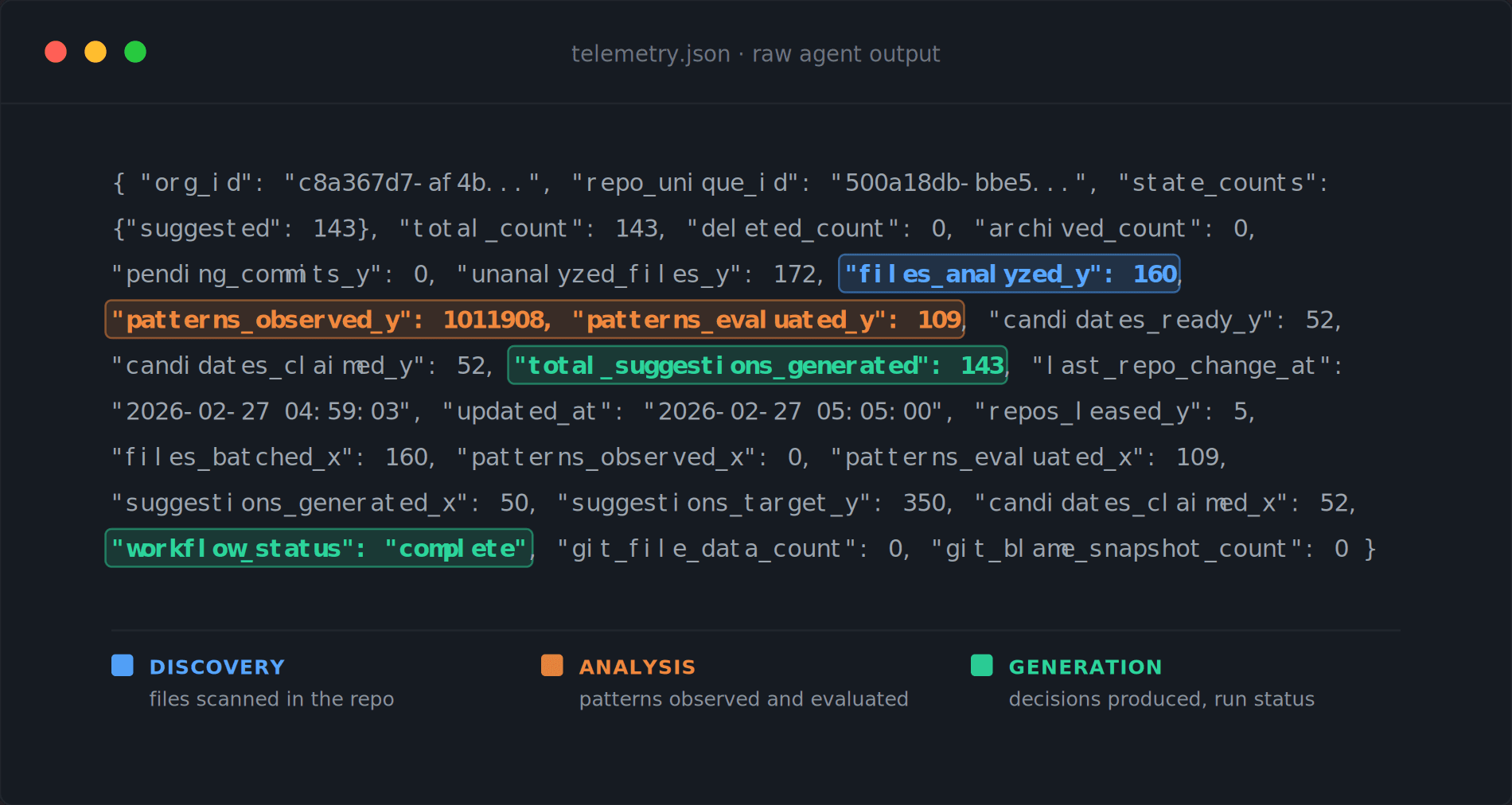
I mapped every field in the payload to the actual work the agent was doing and grouped it into three stages: Discovery, Analysis, Generation. I built the UI in Cursor and shipped it to Storybook the same day. Reading what the engineers were reading was the only way to make it feel accurate.
// Reflection
What I learned.
Learning new tools is part of the job.
Cursor, Claude Code, v0, Bolt — the AI tooling landscape shifted constantly. Getting fluent in each one wasn't a side task. It was the work. The designers who understand these tools are the ones who can actually design for the people using them.
Being open to change.
The tools changed, the product changed, and the way developers worked changed — all within a few months. The job was less about having the right answer and more about being willing to throw out a working version when the ground shifted.